
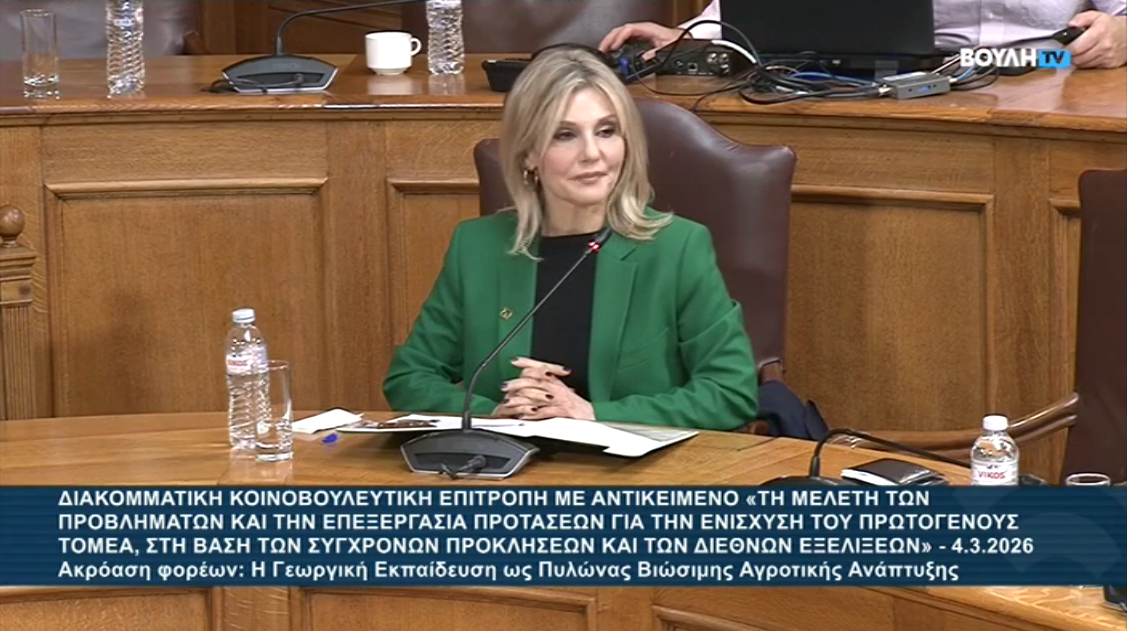
March 4, 2026 – Address to the Interparty Parliamentary Committee
On March 4, 2026, a session of the Interparty Parliamentary Committee was held with the objective of examining key challenges and formulating proposals to strengthen the primary sector in light of contemporary challenges and international developments.
During the session, Efi Lazaridou, CEO of New Agriculture New Generation, delivered a statement focusing on agricultural education as a key pillar for sustainable rural development.
The Role of Agricultural Education Today
As highlighted in the address, agricultural knowledge today extends far beyond production. It encompasses entrepreneurship, technology adoption, sustainable practices, regulatory compliance, collaboration, and risk management.
At the same time, a significant gap in agricultural education in Greece continues to act as a barrier to modernization and competitiveness. Indicatively, 9 out of 10 farm managers lack formal agricultural training, while even among younger generations, the percentage of those with comprehensive agricultural education remains extremely low.
Three Key Areas of Intervention
The address focused on three core areas of intervention considered essential for strengthening the sector:
Knowledge transfer networks and farmer-to-farmer learning
Particular emphasis was placed on Demonstration Farm Networks and farmer-to-farmer learning as effective mechanisms for disseminating practical knowledge at scale.
Although these tools are already included in Greece’s Common Agricultural Policy Strategic Plan, they have yet to be fully implemented at the national level. At the same time, New Agriculture New Generation is already applying these methodologies through pilot initiatives with measurable impact.
Strengthening processing and cottage industry activity
The address also highlighted the need to support producers in developing processing and cottage industry activities through:
- lifelong learning initiatives
- tailored advisory services
- stronger connections with markets and specialized professionals
A key priority identified is the establishment of a comprehensive support mechanism—a “one-stop shop”—to guide producers from concept to market.
Developing leadership skills in the agri-food sector
Special emphasis was placed on the need to cultivate leadership skills among agri-food professionals.
The goal is to foster a new generation of producers who:
- combine knowledge with practical skills
- understand the sector at both micro and macro levels
- drive innovation and collaboration
- actively contribute to the transformation of the sector
In this context, strengthening soft skills, networking, and access to high-level institutional and business environments is considered essential.
The Four Proposals
The four proposals presented during the intervention are as follows:
First – National skills targets: Establish modern, measurable targets based on real socio-economic impact rather than simple participation in programs, with consistent annual monitoring.
Second – Immediate implementation of AKIS provisions: Activate Demonstration Farm Networks and farmer-to-farmer learning networks across the country, with regional specialization based on local production priorities.
Third – Creation of a one-stop shop support system: Provide structured advisory and guidance services for producers entering processing and cottage industry, ensuring access to business knowledge and tailored consulting.
Fourth – Ambitious collective initiatives and leadership development programs: Strengthen professionals who can assume leadership roles in the agricultural sector through high-impact training and networking initiatives.
Concluding Remarks
As emphasized in the address, agri-food is a matter of national importance, as it directly relates to food production, rural sustainability, and regional cohesion.
New Agriculture New Generation remains committed to contributing actively to this national effort through applied education, knowledge transfer networks, and the strengthening of agri-food entrepreneurship across Greece.