
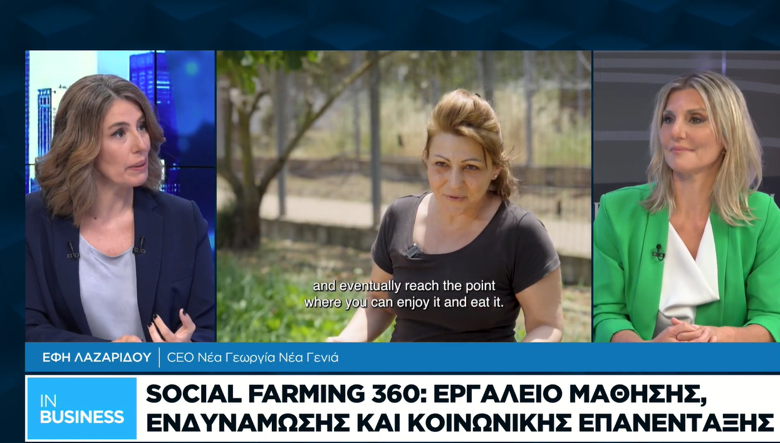
Efi Lazaridou, Chief Executive Officer of New Agriculture New Generation, spoke to Naftemporiki TV – IN BUSINESS about the social impact, methodology and results of the Social Farming 360 programme.
The interview highlighted the role of social farming as a tool for education, empowerment and support for the reintegration of people living in agricultural correctional facilities. The programme was completed in June 2026 after two years of implementation, combining agricultural training, employment support and psychosocial care.
The programme’s starting point
Asked what Social Farming 360 is, when it began and what its core objective was, Ms Lazaridou explained that it was a holistic social farming initiative implemented in facilities with agricultural production.
As she noted:
“It was an effort to transform agricultural production within agricultural correctional facilities. In essence, it is an effort to support people’s reintegration into society on the next day, once they have completed their sentence.”
The intervention focused on helping participants acquire knowledge and practical skills related to agriculture and food production, while also providing support on employment and mental-health-related issues. The programme was selected for funding by Citi Foundation through an international call and was implemented between 2024 and 2026.
Agriculture, employment and reintegration
The discussion placed particular emphasis on the importance of supporting people who often remain invisible to society, as well as on the potential to link reintegration with a sector that needs human resources.
When asked how this type of training can meaningfully contribute to participants’ next steps, Ms Lazaridou underlined:
“We do not only give attention to people who are often invisible inside prisons; we also give them the tools to reintegrate. At the same time, these are people who can become active in the agricultural sector, a sector that needs workforce.”
As she explained, social farming can serve as a setting for socialisation, skills development and the creation of genuine employment prospects for vulnerable social groups.
The scale of the initiative
Asked about the number of facilities and participants involved, Efi Lazaridou stated that the programme reached a total of six facilities with agricultural production: four agricultural correctional facilities and two closed facilities.
Participation was voluntary, and engagement was particularly positive. More than 1,000 participants received training in agriculture and food-production topics, while more than 300 people received psychosocial and employment support.
The training covered contemporary agricultural practices, with an emphasis on environmentally sustainable and regenerative approaches. Activities included the cultivation of aromatic and medicinal plants, such as oregano and thyme, the development of vegetable gardens, and plant propagation.
“It was important to transfer knowledge to participants on new practices that relate to regenerative agriculture and more environmentally sustainable approaches,” Ms Lazaridou noted.
A collaboration with meaningful impact
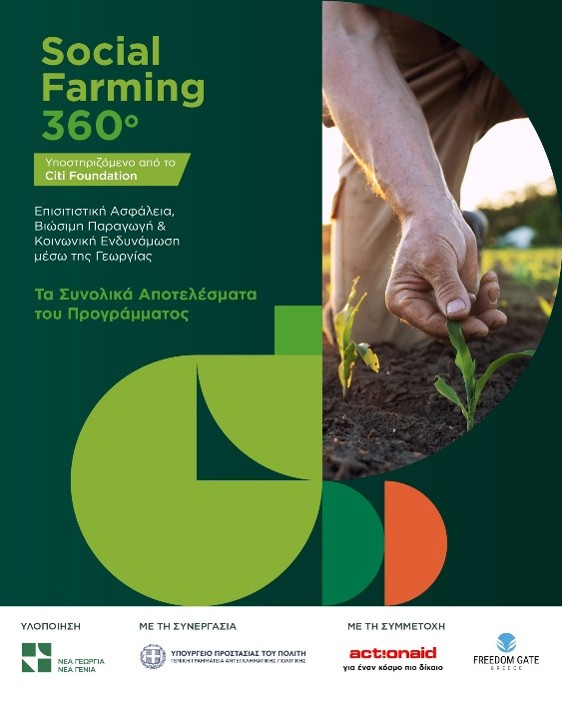
The implementation of Social Farming 360 was based on the collaboration of public and social-sector organisations. New Agriculture New Generation was responsible for agricultural training; ActionAid Hellas supported the employment empowerment component; and Pyles Eleftherias provided psychosocial support services.
The contribution of the General Secretariat for Anti-Crime Policy of the Ministry of Citizen Protection, the management teams of the facilities, and the agronomists and staff working in them was also crucial.
The interview also referred to the programme’s short documentary, in which participants share personal experiences of taking part in the initiative. Ms Lazaridou stressed that the testimonies were recorded authentically, without intervention in the content of those who chose to speak.
When asked about what might follow after the programme’s completion, Efi Lazaridou expressed her hope that the experience of Social Farming 360 could serve as a foundation for the continuation and expansion of similar initiatives.
“It would be highly desirable to see an initiative like this—one that has been designed, implemented, measured and proven useful—embraced by the State and applied in other facilities as a practice with continuity.”
Agricultural training, psychosocial support and career guidance are, as she explained, crucial components in supporting reintegration and creating new prospects.
“We are talking about skills, psychological support and employment support. These give people the opportunity to dream and hope for a different future.”
Learn more about the programme’s social impact and watch the documentary, featuring testimonials from programme beneficiaries.
Watch the full interview on the organisation’s YouTube channel.